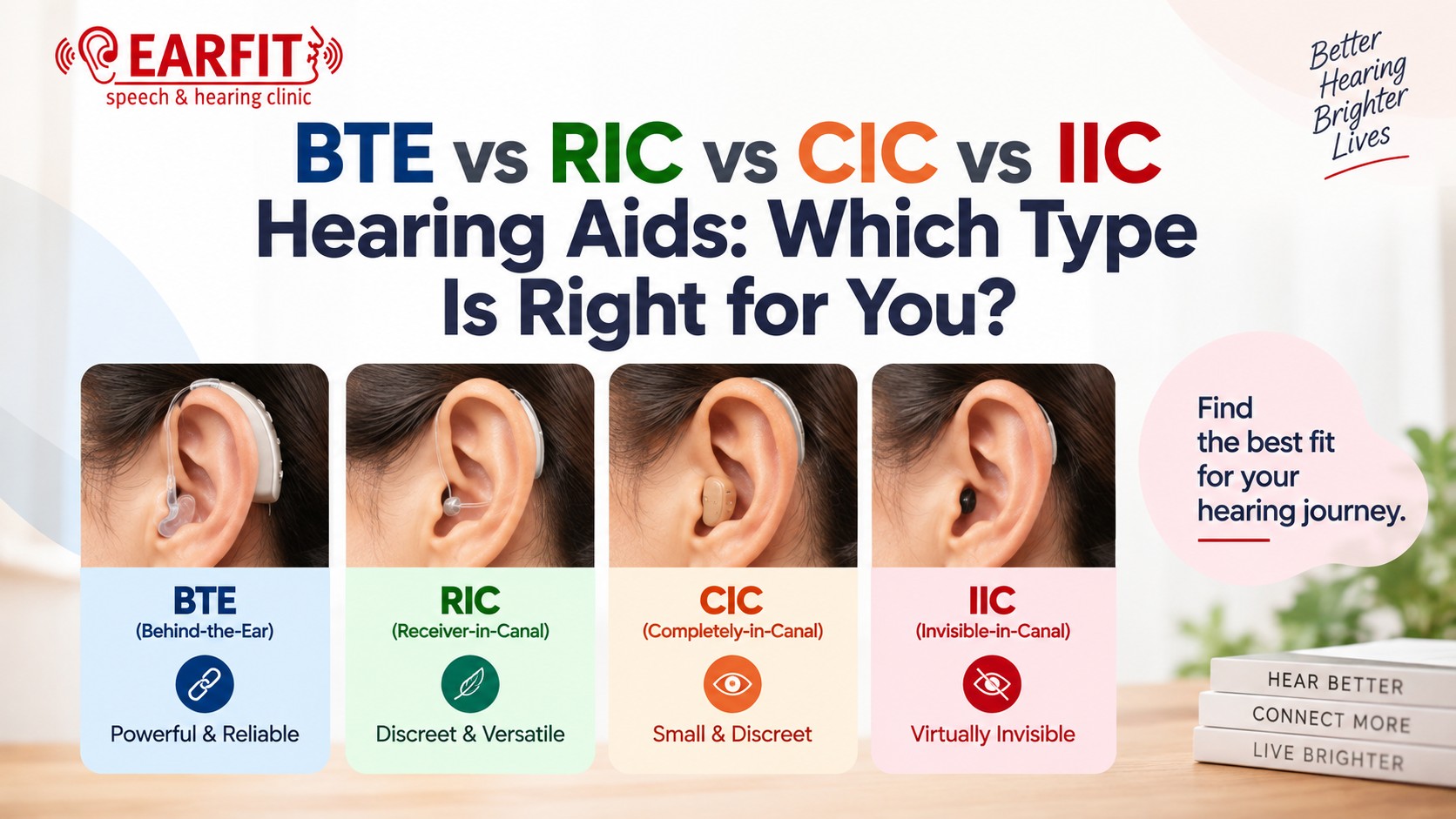
If you or someone you love has recently been advised to get a hearing aid, you have probably run into a wall of acronyms, BTE, RIC, CIC, IIC and wondered what any of it actually means for daily life. The truth is, the best hearing aid isn’t a single device, it’s the device that fits your ear anatomy, your hearing loss profile and how you actually live.
At Earfit Speech & Hearing Clinic in Bangalore, we fit all four major hearing aid styles every week, for patients ranging from schoolchildren to working professionals to seniors managing severe hearing loss. This guide breaks down exactly how BTE, RIC, CIC and IIC hearing aids differ, who each one suits best, and how to make a confident, informed decision, ideally after a proper hearing test, not guesswork.
Understanding Hearing Aid Styles
Before comparing the four types, it helps to understand what actually varies between them. Every hearing aid style differs along a few key dimensions:
- Placement: where the device sits (behind the ear, in the ear canal, or fully hidden inside it)
- Size: which affects battery life, features and how easy it is to handle
- Visibility: how noticeable the device is to others
- Power: how much amplification it can deliver, which matters for the degree of hearing loss
- Features: Bluetooth streaming, rechargeability, directional microphones and more
These trade offs are why an audiologist will always ask about your hearing test results, ear canal shape, dexterity and lifestyle before recommending a style, the same hearing loss can call for different devices in two different people.
Overview of the Four Hearing Aid Types
BTE (Behind the Ear)
BTE hearing aids sit behind the ear, with the main body housing the microphone, battery and processor, connected by a thin tube or wire to an earmold or dome inside the ear canal. They are the most powerful and versatile style available.
RIC / RITE (Receiver in Canal)
RIC hearing aids are a slimmer evolution of the BTE. The main body still sits behind the ear, but instead of piping sound through a tube, the speaker (receiver) itself sits inside the ear canal, connected by a thin wire. This design is smaller, more natural sounding and currently the most commonly prescribed style worldwide.
CIC (Completely in Canal)
CIC hearing aids are custom molded to sit almost entirely inside the ear canal, with only a small removal handle visible. They are discreet and give a natural listening experience, but their small size limits battery life and power.
IIC (Invisible in Canal)
IIC hearing aids go a step further than CIC, they sit deep inside the canal, close to the eardrum, making them virtually invisible from the outside. They are the smallest hearing aid category available today.
BTE Hearing Aids: Features, Benefits & Limitations
Who they are for: People with mild to profound hearing loss, young children, people with dexterity or vision challenges and anyone who needs maximum power or battery life.
Benefits:
- Highest power output, suitable even for severe to profound hearing loss
- Largest battery, so longest battery life or easiest rechargeable options
- Easiest to handle, clean and adjust, good for seniors or first time users
- Most durable against moisture and earwax
- Widest range of features: Bluetooth streaming, telecoil, directional microphones, tinnitus masking
Limitations:
- Most visible of the four styles, sitting openly behind the ear
- Can feel warm or heavy behind the ear in hot, humid climates like Bangalore’s
- Glasses or masks worn regularly can occasionally interfere with fit
RIC Hearing Aids: Features, Benefits & Limitations
Who they are for: The majority of first-time users with mild to severe hearing loss who want a balance of discretion, sound quality and modern features.
Benefits:
- More natural, open sound because the receiver sits closer to the eardrum
- Smaller and less visible than BTE
- Excellent for Bluetooth streaming to smartphones, TVs, and calls
- Available in both rechargeable and disposable-battery models
- Reduces the plugged up or occluded feeling some users get with BTE earmolds
Limitations:
- The thin wire and receiver are more delicate and may need earwax related servicing more often
- Slightly less powerful than BTE at the highest end of severe hearing loss
- Not ideal for people with very narrow or complex-shaped ear canals
CIC Hearing Aids: Features, Benefits & Limitations
Who they are for: Adults with mild to moderately severe hearing loss who prioritize a low profile and don’t mind smaller batteries.
Benefits:
- Sits inside the canal, largely hidden from view
- Reduces wind noise since the microphone sits inside the ear
- Compatible with phone use and headwear without interference
- Custom molded for a precise, comfortable fit
Limitations:
- Smaller battery means shorter battery life and usually no telecoil
- Limited or no Bluetooth/rechargeable options depending on the model
- Not recommended for young children or people with very small or narrow canals
- Slightly trickier to insert, remove and clean for those with limited dexterity or arthritis
IIC Hearing Aids: Features, Benefits & Limitations
Who they are for: People with mild to moderate hearing loss who want maximum discretion and have a suitably sized, healthy ear canal.
Benefits:
- Virtually invisible, sits deep in the canal, out of sight
- Because it sits close to the eardrum, sound quality can feel very natural
- No interference with glasses, earphones, helmets, or masks
- Great option for people self conscious about visible hearing aids
Limitations:
- Smallest battery of all styles, so most frequent battery changes and shortest lifespan per charge
- Not suitable for severe or profound hearing loss
- Limited feature set, often no Bluetooth or manual controls due to size
- Requires a healthy, adequately sized ear canal, and more frequent professional cleaning since it sits close to earwax-producing areas
- Not ideal for people with recurring ear infections or excessive earwax buildup
BTE vs RIC vs CIC vs IIC: Quick Comparison
| Feature | BTE | RIC | CIC | IIC |
|---|---|---|---|---|
| Placement | Behind the ear | Behind ear, receiver in canal | Inside canal | Deep inside canal |
| Visibility | Most visible | Low visibility | Very low visibility | Virtually invisible |
| Size | Largest | Medium-small | Small | Smallest |
| Suitable hearing loss | Mild to profound | Mild to severe | Mild to moderately severe | Mild to moderate |
| Sound quality | Very good | Excellent, natural | Good, natural | Very natural (close to eardrum) |
| Feedback/whistling risk | Low with proper fit | Low | Moderate | Moderate |
| Bluetooth/connectivity | Widely available | Widely available | Limited | Rare |
| Rechargeable option | Yes, common | Yes, common | Limited | Rare |
| Battery type | Larger, longer lasting | Small medium | Small | Smallest, frequent changes |
| Ease of handling | Easiest | Easy | Moderate | Requires dexterity |
| Suitable for seniors | Excellent | Good | Case by case | Case by case |
| Suitable for active users | Good | Excellent | Good | Good, if canal permits |
| Durability | Highest | High | Moderate | Moderate |
| Earwax considerations | Least affected | Some sensitivity | More sensitive | Most sensitive |
| Maintenance | Low | Low-moderate | Moderate | Higher, regular cleaning |
| Lifestyle suitability | All lifestyles | Active, tech savvy users | Everyday, low key use | Discretion focused users |
| Approx. price in Bangalore | Moderate to premium | Moderate to premium | Moderate | Premium |
| Key advantages | Power, battery, durability | Natural sound, connectivity | Discretion, comfort | Maximum invisibility |
| Key limitations | Visibility | Wax sensitivity | Fewer features | Least power, most upkeep |
Note: Exact pricing varies by brand, technology level and features. Our audiologists at Earfit can walk you through current options across Phonak, Signia, Widex, Oticon, Resound, Starkey and Unitron during your consultation.
Which Hearing Aid Is Right for You?
There’s no universal winner, the right choice depends on your specific situation. Here’s a practical decision framework:
- Mild hearing loss: RIC, CIC, or IIC are usually all viable, the decision often comes down to visibility preference and ear canal size.
- Moderate hearing loss: RIC is typically the sweet spot of power, comfort, and features, CIC can also work well.
- Severe hearing loss: BTE is usually recommended for its power and reliability, some advanced RIC models can also handle severe loss.
- Discreet, near-invisible option preferred: IIC is the top choice, provided your ear canal is suitable.
- Bluetooth and smart features important: BTE and RIC offer the widest range of connectivity options.
- Seniors who need easy handling: BTE is generally easiest to insert, remove, clean and operate.
- Active lifestyle (sports, outdoor activity, gym): RIC or BTE, both of which handle movement and sweat better with the right accessories.
- Frequent earwax buildup: BTE or RIC are more forgiving; CIC and IIC require more regular professional cleaning.
- Better sound quality and clarity in noisy environments: RIC and BTE models generally offer more advanced noise reduction technology.
- Budget considerations: BTE and RIC tend to offer the most value across power levels, CIC and IIC, being custom made, can carry a premium.
Ultimately, the right choice depends on your hearing test results, ear anatomy, dexterity and how you plan to use the device day to day. This is exactly why a professional consultation, not an online quiz or guesswork, should guide the final decision.
Importance of a Hearing Test Before Choosing a Hearing Aid
No hearing aid style should be chosen before a proper diagnostic hearing test. A comprehensive assessment measures the degree and pattern of your hearing loss (mild, moderate, severe, or profound), which frequencies are affected, and whether the loss is conductive, sensorineural, or mixed. It also rules out other causes, such as earwax blockage or middle ear issues, that may need different treatment entirely.
At Earfit, every consultation begins with a free, no obligation hearing test, followed by a discussion of your results, lifestyle, and preferences before we recommend specific hearing aid styles or brands. This is the same approach recommended by hearing health bodies worldwide: match the device to the diagnosis, not the other way around.
Hearing Aid Technology Features to Consider
Beyond style, the technology inside the device matters just as much:
- Bluetooth connectivity: stream calls, music, and TV audio directly to your hearing aids
- Rechargeability: no more fumbling with tiny batteries, most modern BTE and RIC models now offer this
- Noise reduction and directional microphones: helps you follow conversations in busy places like restaurants or markets
- Tinnitus masking features: built into several brands for patients who also experience ringing in the ears
- Fall detection and health tracking: available in select models, useful for seniors living independently
- Telecoil compatibility: useful for phone calls and looped public spaces like auditoriums
Hearing Aid Price in Bangalore
Hearing aid pricing in Bangalore varies widely depending on the brand, technology tier (basic, mid range, or premium) and features like Bluetooth or rechargeability. As a general guide, entry level digital hearing aids sit at the more affordable end, while premium AI powered, rechargeable, Bluetooth enabled devices from brands like Phonak, Signia, or Oticon sit at the higher end. Because pricing changes with promotions and new model launches, we recommend getting a personalised quote during your consultation rather than relying on generic online estimates. Earfit also offers EMI options to make advanced hearing aids more accessible.
Why Choose Earfit for Hearing Aids in Bangalore?
Earfit Speech & Hearing Clinic has built its reputation in Bangalore on personalized, no pressure hearing care, not just selling devices. Here’s what sets our approach apart:
- Experienced, certified audiologists who explain your results and options without technical jargon
- Free hearing tests with no obligation to purchase
- Access to all major global brands, Phonak, Signia, Widex, Oticon, Resound, Starkey, and Unitron
- In clinic and home visit services, so families across Bangalore can get expert care conveniently
- On site repair and servicing, with many minor issues resolved the same day
- Speech therapy support for both children and adults alongside hearing care
We currently serve patients from two convenient locations: Basavanagudi, in the heart of South Bangalore near National College Metro Station and Konanakunte, along Anjanapura Main Road. Whether you are coming from Jayanagar, JP Nagar, Banashankari, BTM Layout, or further afield, both clinics are easy to reach and staffed with the same standard of expert, patient first care.
Frequently Asked Questions
Which is better, BTE or RIC?
Neither is universally better, BTE offers more power and durability, while RIC offers a smaller size and more natural sound. The right choice depends on your degree of hearing loss and personal preference.
Is RIC better than CIC?
RIC generally offers more features (Bluetooth, rechargeability) and handles a wider range of hearing loss, while CIC offers slightly more discretion. Both are excellent options depending on your priorities.
Which hearing aid is least visible?
IIC (Invisible in Canal) hearing aids are the least visible, sitting deep inside the ear canal.
Is IIC better than CIC?
IIC is smaller and more discreet, but CIC generally offers a bit more power, battery life and feature options. It depends on your hearing loss severity and canal shape.
Which hearing aid is best for seniors?
BTE hearing aids are usually easiest for seniors to handle, insert and maintain, especially for those with limited dexterity or vision.
Which hearing aid is best for severe hearing loss?
BTE hearing aids are typically recommended for severe to profound hearing loss due to their higher power output.
Which hearing aid is easiest to use?
BTE hearing aids are generally the easiest to insert, remove, and operate, thanks to their larger size and controls.
Are RIC hearing aids rechargeable?
Yes, most modern RIC hearing aids from major brands offer rechargeable options alongside traditional battery models.
How long do hearing aids last?
With proper care, most hearing aids last around 4 to 6 years, though this varies by usage, maintenance and technology level.
How much do hearing aids cost in Bangalore?
Costs vary based on brand and technology tier. Basic digital models are more affordable, while premium rechargeable, Bluetooth enabled devices cost more. Book a consultation with Earfit for a personalized quote.
Can hearing aids connect to a smartphone?
Yes, most modern BTE and RIC hearing aids, and select CIC models, support Bluetooth streaming for calls, music and app based adjustments.
Do invisible hearing aids (IIC) work well?
Yes, for mild to moderate hearing loss and suitable ear canal anatomy, IIC hearing aids offer very natural sound quality, though with fewer features than larger devices.
Can I choose a hearing aid without a hearing test?
No, a proper diagnostic hearing test is essential to determine the right style and power level for your specific hearing loss.
Which hearing aid is best for an active lifestyle?
RIC and BTE hearing aids tend to hold up best during sports, workouts and outdoor activities, especially with sweat resistant accessories.
What is the difference between CIC and IIC?
CIC sits inside the outer part of the ear canal with a small visible handle, while IIC sits deeper, closer to the eardrum, making it nearly invisible.
Do hearing aids need regular maintenance?
Yes, regular cleaning, earwax checks, and professional servicing (available on site at Earfit) help hearing aids perform well and last longer.
Conclusion
Choosing between BTE, RIC, CIC and IIC hearing aids isn’t about picking the best style in the abstract, it’s about matching the device to your hearing loss, ear anatomy, lifestyle and comfort with technology. BTE offers unmatched power and durability, RIC balances natural sound with smart features, CIC provides a discreet everyday option and IIC offers maximum invisibility for the right candidate.
The most reliable way to find your fit is a professional hearing test followed by an honest conversation with an audiologist about your daily life and priorities. At Earfit Speech & Hearing Clinic, our team in Basavanagudi and Konanakunte is here to guide you through that process, with free hearing tests and no pressure to buy.
Ready to find the right hearing aid for you? Book a free hearing test with Earfit today or call us at +91 988 605 0101.