
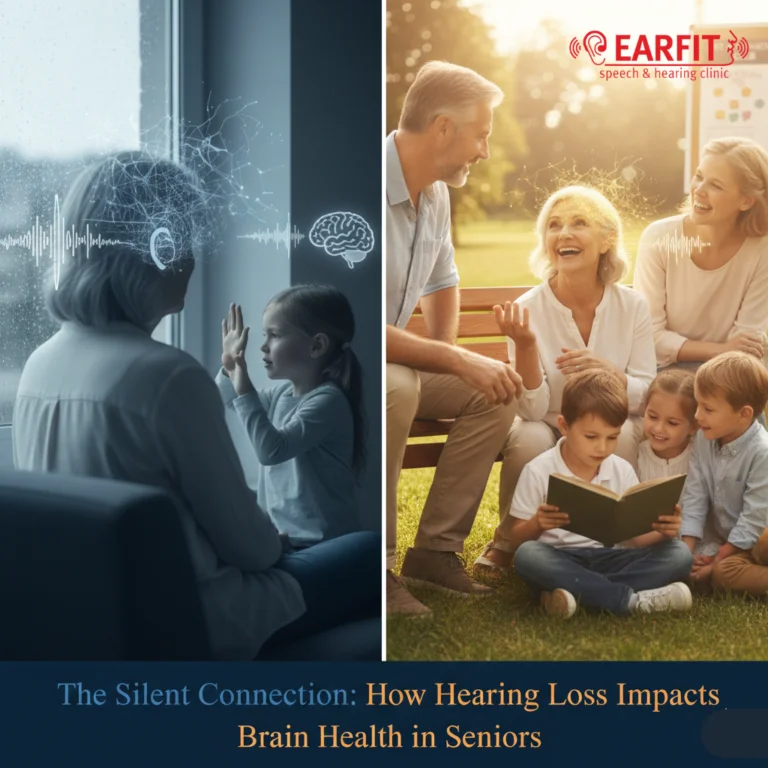
The Silent Connection: How Hearing Loss Impacts Brain Health in Seniors
Aging is often viewed as a series of physical changes, we expect the joints to stiffen or the vision to blur. However, one of the most common side effects of aging is frequently underestimated hearing loss.
For many seniors, losing their hearing is seen as a minor inconvenience or a natural part of getting older. But modern science tells a much more complex story. Hearing isn't just about your ears; it's a fundamental brain function. When your ears struggle to pick up sound, your brain is forced to pick up the slack, leading to a ripple effect that touches everything from memory to emotional well-being.
In this guide, we will explore the deep-rooted connection between untreated hearing loss and cognitive decline, why your brain gets tired from listening and how early intervention can literally save your mind.
2. Understanding Hearing Loss in Seniors
Age related hearing loss, medically known as presbycusis, is the gradual loss of hearing in both ears. It's incredibly common, yet it develops so slowly that many seniors don't realize their world has gone quiet until they are missing significant parts of conversations.
Common Causes
- Aging: Over time, the tiny hair cells in the inner ear (the cochlea) that transform sound waves into nerve signals begin to break down. Once these cells are gone, they do not grow back.
- Noise Exposure: A lifetime of loud environments, whether from construction work, loud music, or power tools, accelerates the degradation of the ear.
- Medical Conditions: Health issues common in seniors, such as diabetes or high blood pressure, can damage the delicate blood flow to the inner ear.
Early Signs Families Often Ignore
It's rarely total silence at first. Instead, it looks like:
- Thinking everyone is mumbling.
- Struggling to hear in noisy restaurants.
- The TV Wars (increasing the volume to levels uncomfortable for others).
- Avoiding phone calls because the audio feels thin or unclear.
3. How Hearing Works with the Brain
To understand the brain-hearing link, we have to look at the delivery system. Your ears are simply the microphones, the brain is the sound processor.
- Sound Waves enter the ear canal and vibrate the eardrum.
- The Auditory Nerve carries these vibrations as electrical impulses.
- The Auditory Cortex (in the brain) interprets these pulses as music, a siren, or a grandchild's voice.
The brain's role goes beyond just hearing the noise. It is responsible for filtering out background noise, focusing on a single speaker, and matching sounds to memories (like recognizing a meow as a cat). When the signal from the ear is weak, the brain has to work overtime to decode a garbled message.
4. Extra Brain Effort
When you have hearing loss, your brain has to work much harder to fill in the blanks. This is known as Cognitive Load.
Imagine trying to read a book where every fifth word is blurred out. You can still understand the story, but you have to use a lot of mental energy to guess the missing words. This is exactly what a senior's brain does during a conversation.
The Results of Mental Fatigue:
- Reduced Focus: Because so much energy is spent on decoding sound, there is less processing power left for understanding the meaning of what is being said.
- Slower Thinking: Processing speeds drop because the brain is stuck in the decoding phase.
- Exhaustion: Many seniors feel physically and mentally drained after a simple social lunch. This isn't just old age, it's listening fatigue.
5. Link Between Hearing Loss and Memory Problems
The Use It or Lose It principle applies heavily to the brain. When hearing loss occurs, the parts of the brain responsible for sound processing receive less stimulation. This lack of input can lead to atrophic shrinking of brain tissue.
Impact on Memory:
- Short-Term Memory: If the brain is too busy trying to hear a sentence, it often fails to store that sentence in the short term memory. This is why seniors often forget what was just said.
- Word Recall: A lack of auditory stimulation can make it harder for seniors to "find the right word" during a conversation.
- Processing Speed: As the auditory pathways weaken, the brain's overall ability to process information quickly begins to lag.
6. Hearing Loss and Risk of Cognitive Decline
Perhaps the most startling discovery in recent geriatric research is the link between untreated hearing loss and dementia.
A landmark study by Johns Hopkins University found that seniors with hearing loss are significantly more likely to develop dementia than those with normal hearing. The risk increases with the severity of the loss:
- Mild hearing loss: Double the risk of dementia.
- Moderate hearing loss: Triple the risk.
- Severe hearing loss: Five times the risk.
This happens for three reasons: the brain's "overload" (cognitive load), actual brain shrinkage (atrophy), and the social isolation that follows when communication becomes too difficult.
7. Emotional & Mental Health Impact
Hearing loss is an invisible disability that carries a heavy emotional burden. When a senior can't follow a joke or misses a secret shared by a toddler, they don't just feel quiet, they feel disconnected.
- Frustration and Confusion: Constantly asking people to repeat themselves leads to irritability.
- Anxiety: The fear of mishearing something important or responding inappropriately in public can cause significant stress.
- Depression: As the world goes quiet, the sense of self can diminish, leading to a loss of confidence and a feeling of being a burden to the family.
8. Social Isolation and Brain Health
Human beings are hard wired for connection. For seniors, hearing loss is a social wedge.
When it becomes too difficult to follow conversations in groups, the natural instinct is to withdraw. They might stop going to church, skip family dinners, or stay home instead of meeting friends for coffee.
Loneliness is toxic to the brain. Social isolation is a known risk factor for cognitive decline because it reduces the mental exercise that comes from interacting with others. Communication is the best "brain gym," and hearing loss closes the doors to that gym.
9. Safety Risks Related to Brain Function
Hearing loss isn't just a communication issue; it's a safety issue. The brain uses sound to map our environment and keep us safe.
- Missing Alarms: Not hearing a smoke detector, a boiling kettle, or a doorbell.
- Slower Reaction to Danger: In traffic, hearing a car horn a split second late can be the difference between safety and an accident.
- Increased Fall Risk: Studies show that even mild hearing loss triples the risk of an accidental fall. This is because the brain is so preoccupied with "hearing" that it pays less attention to balance and gait.
10. Can Hearing Treatment Protect Brain Health?
The good news is that the brain is remarkably resilient. Hearing aids are not just amplifiers, they are cognitive support devices.
- Brain Stimulation: By restoring the sound signal, hearing aids provide the brain with the stimulation it needs to keep the auditory cortex active.
- Reducing Effort: When the sound is clear, the brain can stop guessing and start listening. This frees up mental energy for memory and focus.
- Preserving Cognition: Recent studies suggest that wearing hearing aids can actually slow the rate of cognitive decline by keeping the wearer socially engaged and mentally active.
11. Importance of Early Hearing Tests for Seniors
Many seniors wait an average of 7 to 10 years before seeking help for hearing loss. This is a critical mistake.
The longer the brain goes without sound, the more it "forgets" how to process it. This is why people who wait a long time to get hearing aids often find them "too noisy", their brain has lost the ability to filter out background sounds.
Recommendation:
- Seniors should have a baseline hearing test at age 60.
- Follow up tests should occur every 1-2 years, just like vision or dental exams.
12. How Families Can Support Seniors
If you suspect a loved one is struggling, your support is vital. The stigma of looking old often prevents seniors from getting help.
- Watch for the Signs: Notice if they are "zoning out" during dinners or if they've stopped using the phone.
- Encourage, Don't Nag: Frame the conversation around brain health and connection, rather than broken ears.
- Be Patient: Face the person when speaking, speak clearly (don't shout), and minimize background noise.
- Normalize Hearing Aids: Compare them to glasses. We don't judge people for wearing glasses to see, we shouldn't judge them for wearing hearing aids to hear.
13. When to See an Audiologist
If you or a loved one are experiencing any of the following, it is time for a professional evaluation:
- Frequently asking people to repeat themselves.
- Thinking everyone is mumbling or talking under their breath.
- Difficulty hearing women's or children's voices.
- Ringing in the ears (tinnitus).
What Happens During an Evaluation?
An audiologist will perform a comprehensive hearing exam, which includes looking inside the ear and testing your ability to hear different frequencies and understand speech in noise. It is painless, non-invasive, and the first step toward a healthier brain.
14. Myths About Hearing Loss & Brain Health
- Hearing loss is just a normal part of aging.
- Truth: While common, it is a medical condition with serious consequences for your brain. You wouldn't ignore a heart condition just because it's common.
- "Hearing aids won't help me."
- Truth: Modern hearing technology is AI driven, discreet and highly effective at filtering noise and clarifying speech.
- "It's too late to treat it."
- Truth: It is never too late to provide the brain with more stimulation and improve your quality of life.
15. Conclusion
Hearing loss is far more than an ear problem. It is a significant health issue that affects the very fabric of how our brains function as we age. By ignoring the signs of hearing loss, we aren't just missing out on the sounds of the world, we are putting our memory, our cognitive health, and our emotional well being at risk.
The link between the ears and the brain is undeniable. However, with early diagnosis and modern treatment, seniors can stay sharp, stay connected and keep their brains healthy for years to come.
Don't wait for the silence to become permanent. Take the first step toward protecting your brain today.