
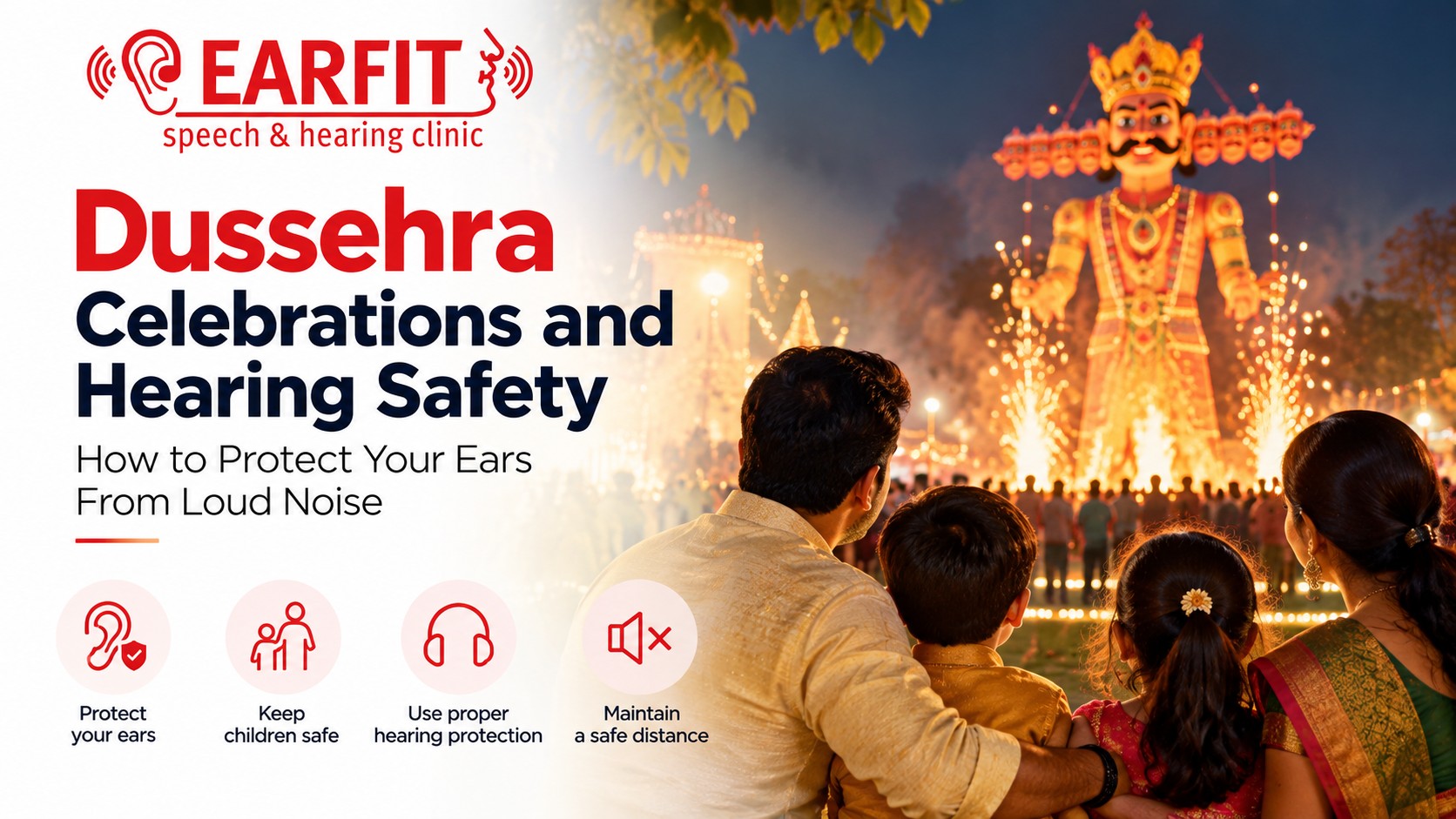
- Written by the Earfit Speech & Hearing Clinic team and medically reviewed by Dr. Jithin Abraham Paul, Certified Audiologist and Founder, Earfit Speech & Hearing Clinic, Bangalore.
Celebrate Dussehra Without Compromising Your Hearing
Dussehra is a season of family gatherings, processions, music, cultural programmes and in many neighbourhoods, fireworks and the burning of effigies. It is a joyful time and it is also one of the noisiest times of the year.
The short answer: to protect your hearing during Dussehra, stay as far as you can from loud sound sources, limit how long you spend in noisy areas, use properly fitted hearing protection when you cannot avoid loud sound, keep children well away from firecrackers and get your ears checked by an audiologist if ringing, muffled hearing or difficulty understanding speech does not settle down.
Loud sound can harm hearing depending on three things: how intense it is, how long you are exposed and how close you are to the source. A single very loud sound, such as a firecracker exploding nearby, can injure the ear immediately. Long hours near loudspeakers can do damage more gradually. Neither always hurts, which is why many people do not realise anything is wrong until later.
In this guide, the audiology team at Earfit Speech & Hearing Clinic explains how noise affects your ears, which Dussehra sounds deserve extra caution, seven practical protection tips, how to include older relatives in celebrations, what hearing aid users should know, and when to see a professional. The advice is general and educational. It does not replace an individual assessment by a qualified audiologist or doctor.
Why Is Hearing Safety Important During Dussehra?
Your ears turn sound into signals for the brain. Deep inside the inner ear sits the cochlea, which contains thousands of tiny sensory hair cells. These cells detect sound vibrations and pass them on to the hearing nerve. They are delicate and in humans they do not grow back once they are damaged.
Two factors decide how risky a sound is:
- Intensity (loudness): measured in decibels (dB). The decibel scale is logarithmic, so a small rise in numbers is a big rise in sound energy.
- Duration: the longer you stay in loud sound, the greater the cumulative load on the inner ear.
As a widely used reference point, the World Health Organization’s safe listening guidance is built around about 85 dB for up to eight hours. For every 3 dB increase above that, the safe listening time is roughly halved. That is why a loud procession speaker or a crowded event can become risky within minutes, not hours.
Impulse sounds, which are sudden, extremely loud bursts such as firecrackers and crackers, are a separate concern. Their peak levels can be high enough to injure the ear almost instantly, even from a single exposure. Occupational safety bodies treat peak impulse levels around 140 dB as a point beyond which unprotected exposure should not occur. India’s pollution control rules also set limits on the noise firecrackers may produce, which is a useful reminder that these sounds are taken seriously from a public health point of view.
One more point matters: hearing damage can happen without pain. You may feel fine at the event and notice a problem only that night or the next morning.
How Loud Noise Can Affect Your Ears
After heavy noise exposure, people commonly notice one or more of the following:
- Temporary muffled hearing. Sounds seem dull or distant, as though your ears are full of cotton. Doctors call this a temporary threshold shift. It often improves within hours or days, but it is a signal that your ears were stressed.
- Ringing, buzzing or hissing (tinnitus). Many people experience short lived ringing after a loud event. If it lasts more than a day or two, or keeps returning, it deserves professional attention.
- Difficulty understanding speech. You can hear that people are talking but struggle to make out words, especially in groups or background noise.
- Permanent noise induced hearing loss. With a very loud exposure, or with repeated exposures over time, some of the damage may become permanent. Noise induced hearing loss is usually painless, gradual and once established, cannot be reversed, though it can be managed.
Noise-induced hearing loss is entirely preventable, which is why a little care during festivals goes a long way.
Common Sources of Loud Noise During Dussehra Celebrations
Not every part of Dussehra is loud, but several common elements can be. Knowing them helps you plan where to stand and how long to stay.
- Firecrackers and fireworks. The sharpest and most dangerous noise source because of their sudden, extreme peaks. Bursting crackers, sound focused crackers and large aerial shells close to the ground are the main concern.
- Public address systems and loudspeakers. Announcements, cultural programmes and devotional or film music through large speakers can stay loud for hours and standing near the speaker stack raises the exposure considerably.
- Processions, drums and amplified music. Dhols, nagaras, bands and vehicle mounted sound systems combine rhythmic bursts with sustained loudness, often in narrow streets where sound bounces back.
- Crowded events with several sound sources. A fair or festival ground may have music, announcements, ride noise, vendors and crowd noise all at once. The combined level can be higher than any single source, and it is harder to find a quiet corner.
Why Distance and Exposure Time Matter
Sound weakens as it travels, so moving away from a loud source reduces what reaches your ears. Cutting the time you spend in a noisy area lowers the total dose as well. These two habits are the simplest and most effective protections you have.
There are limits to this, though. Sound levels vary a lot between events and locations. Echo from buildings, narrow lanes and enclosed halls can keep levels high even at a distance, and a sudden firecracker close by can be loud enough to hurt even if the rest of the event is comfortable. Distance helps, but distance alone does not guarantee safety. If sound feels uncomfortably loud, it already is too loud for your ears.
7 Practical Tips to Protect Your Ears During Dussehra
1. Maintain a Safe Distance From Loud Sound Sources
Do not stand next to loudspeakers, speaker stacks, dhol groups or fireworks launch areas. At processions, walk toward the back or side rather than in front of the sound system. At cultural programmes, choose seats that are not directly in front of the speakers. At fireworks displays, follow the organisers safety zones and keep well beyond them where you can.
A practical test: if you have to shout to be heard by someone an arm’s length away, the environment is loud enough to risk your hearing over time.
2. Wear Appropriate Hearing Protection
Properly fitted hearing protection reduces the sound that reaches your inner ear. Options include:
- Foam or reusable earplugs, useful for sustained loudness such as long music events or processions. They only work if inserted correctly and sealed in the canal.
- Earmuffs, which cover the whole outer ear and are easier to fit for many people, including some children.
- Musician style or custom earplugs, which reduce loudness more evenly and keep speech and music clearer. An audiologist can guide you on these.
Please note that for very loud impulse sounds such as firecrackers, ordinary earplugs may not provide enough protection. Hearing protection is a backup, not a licence to stand close. Cotton wool pressed into the ear is not effective protection and can push wax or fibres into the canal, so please avoid it.
3. Limit Time Spent in Noisy Areas
Treat loud environments like strong sunlight: short exposure is far safer than long exposure. Plan breaks, step out of the noisy area every 15 to 20 minutes where possible and leave if the sound feels overwhelming, if your ears start to ring, or if people’s voices begin to sound muffled. If you are part of the organising team, volunteering or performing, arrange rotating breaks for yourself and others near the speakers.
4. Never Lean Over or Stand Close to Firecrackers
Firecrackers cause burns and eye injuries as well as hearing damage, so safety here is about the whole body. Follow official firework safety guidance, light crackers only in open areas and only if you are an adult who is permitted and trained to do so, and never lean over a lit cracker. Keep everyone else, particularly children, at a safe distance. Hearing protection does not replace distance and safe handling.
5. Protect Children’s Hearing
Children are keen to join the fun, and they are often placed close to the action. Their ears are as vulnerable as an adult’s, and they may not tell you that something is too loud.
- Keep children away from firecrackers and speaker stacks.
- Use properly fitted hearing protection where a child must be in a loud environment. Adult earplugs do not fit small ears; child-sized earmuffs are usually easier to use safely.
- Supervise them throughout the event, because children can run toward noise.
- Watch for signs after the event: asking you to repeat things, turning the TV up, complaining of ringing, or seeming unusually quiet or irritable.
Babies and toddlers should be kept well away from loud celebrations altogether. If you notice any change in how a child responds to sound, speak to a paediatrician or audiologist.
6. Be Careful With Headphones After Celebrations
After a loud day, sounds may seem muted and it is tempting to raise the volume on your phone or headphones to compensate. Please avoid this. Turning up the volume on ears that are already stressed adds to the load. Keep volume at a moderate level, take listening breaks and if everyday sounds still seem dull the next day, treat that as a reason to have your hearing checked.
7. Give Your Ears a Quiet Break
Hearing cells need recovery time. After a noisy evening, spend several hours in a quiet environment, ideally a full night, before exposing your ears to loud sound again. Skip loud music, noisy gatherings and long headphone sessions for a while. If hearing and ringing return to normal after rest, good. If they do not, do not simply wait and hope.
How to Make Dussehra More Comfortable for Older Adults With Hearing Loss
For someone with hearing loss, a festival crowd can be tiring and isolating. Conversation gets lost in the noise and many older adults withdraw quietly instead of asking for help. A few changes at home make a real difference:
- Choose quieter areas for family conversations. A calmer corner or room is better than the middle of a busy hall.
- Face the person while speaking and make sure they can see your face. Lip movements and expressions help understanding more than most people realise.
- Avoid talking from another room or while walking away.
- Reduce background music and TV during meals and conversations.
- Encourage the person to use their hearing aids as advised by their audiologist.
- Arrange a hearing evaluation if they regularly miss words, ask for repetition or avoid group conversations. Hearing loss that goes unaddressed can affect confidence, relationships and everyday safety.
How Family Members Can Help
Include older relatives in the conversation without making it a performance:
- Speak clearly at a natural pace instead of shouting, which can distort speech and feels embarrassing.
- Rephrase instead of repeating the same words louder when they have not understood.
- Take turns speaking during group talk so that one voice is heard at a time.
- Give a quick recap of the topic when someone joins, so that they can follow.
- Seat them beside the person they most want to talk to, away from speakers.
- Ask what helps them. Most people can tell you what makes listening easier.
Hearing Safety Tips for Hearing Aid Users During Dussehra
If you wear hearing aids, you may have wondered how they fit into a noisy festival. These points can help:
- Follow the manufacturer’s guidance on using your device in noisy environments.
- Understand that hearing aids are not hearing-protection devices. They amplify sound to help you hear. They do not protect you from loud noise, and in some situations they can make loud sounds more intense.
- Protect devices from fireworks debris, moisture and excessive heat, including crowded, humid or dusty venues. Carry a protective case and a dry cloth.
- Use noise-reduction features only as intended. They can make busy spaces more comfortable, but they do not make dangerously loud environments safe.
- Contact an audiologist if your device sounds different, if sounds feel uncomfortably loud, or if your hearing seems to have changed. If your device needs checking or cleaning, our hearing aid service team can help.
Should You Remove Your Hearing Aids During Fireworks?
The answer depends on the type of device, the environment and your hearing needs, so there is no single rule for everybody. In general, the safest step is to move away from the noise instead of relying on your device to cope with it. If you are in a loud area and cannot leave, some people choose to take their devices out and use proper hearing protection, while others use their audiologist’s advice about settings. Ask your audiologist for individualised guidance before the festival, especially if you have significant hearing loss, tinnitus or sensitivity to loud sounds.
Warning Signs of Noise Related Hearing Problems
Watch for these symptoms after exposure to loud sound:
- Ringing or buzzing in the ears (tinnitus) that does not fade within a day or two.
- Muffled hearing or a feeling of blocked ears, even though there is no cold or wax.
- Difficulty understanding speech, especially in groups or background noise.
- Ear discomfort or pain, or unusual sensitivity to everyday sounds.
Mild, short lived symptoms that fade within hours can occur after loud exposure, but they are still a sign that your ears were pushed hard, and you should rest them. Symptoms that persist or keep coming back are not something to ignore.
When Should You Seek Medical Help?
Sudden hearing loss, especially in one ear, needs urgent medical assessment. If your hearing drops suddenly, or you wake up with significantly reduced hearing in one ear, with or without ringing or dizziness, do not wait for it to pass. Prompt evaluation by an ENT doctor can matter, because some causes of sudden hearing loss are treatable and earlier care generally gives a better chance of recovery. A routine hearing test alone should not delay urgent medical care.
Seek professional evaluation as well if you have:
- Ringing, muffled hearing or other symptoms that continue beyond a day or two.
- Ear pain, discharge or bleeding after an exposure to a loud blast.
- Dizziness or balance problems together with hearing change.
- Hearing that does not return to your normal after a few days of rest.
When Should You Book a Hearing Test in Bangalore?
A hearing test is a quick, painless way to find out how well you hear and whether anything has changed. A professional hearing assessment can help evaluate:
- How well you hear different pitches and volumes.
- Whether any hearing loss is present, and how mild or significant it is.
- Whether the pattern looks typical of noise exposure or suggests another cause.
- Whether you need medical referral, further tests, or hearing support.
It also helps to separate temporary symptoms from concerns that need attention. Brief ringing that settles after a night’s rest is different from hearing that stays muffled, ringing that persists, or sudden hearing loss, which needs urgent care as described above.
Consider booking a hearing test if:
- You keep asking people to repeat themselves.
- You find it hard to follow conversations in groups or noisy places.
- You turn the TV or phone volume up more than before.
- Ringing, buzzing or muffled hearing continues after a loud event.
- A child or older family member seems to hear less than before.
- You have been regularly exposed to loud noise for work, music or celebrations.
Earfit Speech & Hearing Clinic offers hearing assessments and care at two locations in Bangalore:
- Basavanagudi: SMS Square, 3/1, Bugle Rock Rd, Gandhi Bazaar, Basavanagudi, Bengaluru, Karnataka 560004.
- Konanakunte: 34, 1st Floor, Vijaya Plaza, No F1, Anjanapura Main Rd, Anjanadri Layout, Konanakunte, Bengaluru, Karnataka 560062.
Clinic hours are Monday to Saturday, 10:00 am to 7:00 pm, and Sunday closed. Call or WhatsApp +91 988 605 0101 or use the appointment form. Please confirm timings with the clinic during the festival period, as they may change.
How an Audiologist Can Help
An audiologist is a hearing health professional trained to assess, diagnose and manage hearing and balance concerns. During a visit, you can expect:
- A conversation about your symptoms, noise exposure, medical history and daily listening difficulties.
- An ear examination to check for blockages such as wax.
- A hearing evaluation to measure how you hear across different pitches.
- A clear explanation of the results, in everyday language, without pressure.
- Guidance on next steps, which might be monitoring, hearing protection advice, referral to an ENT doctor, or, only if needed, hearing aids tailored to your hearing and lifestyle.
Not everyone who visits needs a device. Sometimes the right answer is reassurance and a plan for protecting your ears better.
Frequently Asked Questions About Dussehra and Hearing Safety
Can firecrackers cause permanent hearing loss?
Yes. A firecracker exploding close to the ear can produce a sound intense enough to damage inner ear cells instantly, and the injury can be permanent. The risk rises with proximity, with repeated exposure, and with the absence of protection. Keeping a safe distance is the most important safeguard.
How can I protect my ears during Dussehra celebrations?
Stay away from speakers and fireworks, limit your time in noisy areas, take quiet breaks, use properly fitted earplugs or earmuffs where appropriate, and keep headphone volume moderate afterwards. Keep children well away from firecrackers.
Are earplugs enough to protect hearing from fireworks?
Not always. Ordinary earplugs may not give enough protection against very loud impulse sounds such as firecrackers. Earplugs help in prolonged noise, but they are not a substitute for staying at a safe distance and following safety guidance.
Can loud noise damage hearing even if it does not hurt?
Yes. Noise induced hearing damage is often painless. By the time you notice trouble, hair cells may already be affected, which is why prevention matters.
Why do my ears ring after a loud celebration?
Ringing, or tinnitus, can follow loud noise exposure because the inner ear and hearing pathways have been overstimulated. It often settles within hours or a day or two, but persistent or recurring ringing should be assessed by an audiologist or doctor.
How can parents protect children’s hearing during festivals?
Keep children far from firecrackers and loudspeakers, use child-sized hearing protection if they must be in loud settings, supervise them closely, and limit time in noisy places. Have their hearing checked if you notice changes in how they respond to sound.
Are hearing aids designed to protect ears from loud sounds?
No. Hearing aids amplify sound to help people with hearing loss. They are not hearing-protection devices. Move away from loud noise and ask your audiologist how to manage your device in noisy surroundings.
Should I get a hearing test after exposure to loud noise?
If symptoms such as ringing, muffled hearing or difficulty understanding speech continue beyond a day or two, or if you had a very loud exposure and are concerned, a hearing test is a sensible step. Sudden hearing loss needs urgent medical evaluation.
What should I do if my hearing suddenly becomes muffled?
Stay away from loud sound, avoid turning up headphone volume, and seek prompt medical assessment, especially if it affects one ear, comes with dizziness or pain, or does not improve quickly. Do not wait several days hoping it passes.
When should I consult an audiologist in Bangalore?
Consult an audiologist if you notice ongoing hearing difficulty, persistent ringing, repeated trouble following conversations, or hearing changes in a child or older relative. At Earfit, our team can assess your hearing at our Basavanagudi and Konanakunte clinics.
A Safer, Happier Dussehra Starts With Your Ears
Dussehra is about togetherness, tradition and celebration, and good hearing is what lets you enjoy every part of it, from a grandchild’s laughter to the music of a procession. A few simple habits make a big difference: keep your distance, limit your time near loud sound, protect children, rest your ears afterwards, and take any lingering symptoms seriously.
Concerned about your hearing? Book a hearing consultation with Earfit Speech & Hearing Clinic. Call or WhatsApp +91 988 605 0101, or request an appointment online. Our audiologists will listen to your concerns, explain your results clearly, and recommend only what you need.
References and Further Reading
- World Health Organization: Make Listening Safe and the WHO-ITU global standard for safe listening devices and systems.
- World Health Organization: World Report on Hearing (2021).
- U.S. National Institute on Deafness and Other Communication Disorders (NIDCD): Noise-Induced Hearing Loss.
- U.S. Centers for Disease Control and Prevention (CDC) / NIOSH: Occupational Noise Exposure guidance and impulse noise limits.
- American Speech-Language-Hearing Association (ASHA): Noise and Hearing Loss Prevention.
- Central Pollution Control Board (India): noise standards for firecrackers.
Medical Disclaimer
This article is for general educational purposes and does not replace professional medical advice, diagnosis or treatment. If you experience sudden hearing loss, severe ear pain, bleeding from the ear, or dizziness, seek urgent medical care. For personalised advice, consult a qualified audiologist or ENT doctor.
About the Author
This article was prepared by the Earfit Speech & Hearing Clinic team and reviewed by Dr. Jithin Abraham Paul, a certified audiologist and Founder of Earfit Speech & Hearing Clinic, Bangalore, whose areas of practice include hearing tests, hearing aid consultation, tinnitus management and paediatric audiology.