What Is an Audiometry Test? Complete Guide to How It Works & Why It Matters
1. Introduction: Your Hearing Health Blueprint
In a world driven by communication and sound, the ability to hear clearly is fundamental to our quality of life, cognitive health, and social connection. Yet, hearing loss is often an invisible condition that progresses silently, frequently leading to delays in diagnosis and treatment.
The single most common, accurate and essential tool used to assess a person hearing ability is the Audiometry Test.
This comprehensive, painless evaluation provides an objective map of your hearing system, pinpointing exactly what you can hear and, crucially, what you might be missing. It is more than just a pass/fail screening, it is a detailed diagnostic procedure.
The importance of this early evaluation cannot be overstated. For children, timely diagnosis is critical for speech and language development. For adults and seniors, it is a key factor in maintaining independence, cognitive function and mental well being.
This complete guide will walk you through the specifics of the audiometry test, exploring its various types, the step by step process, how to understand your results and why making it a routine part of your health check up is a decision that truly matters.
2. What Is an Audiometry Test?
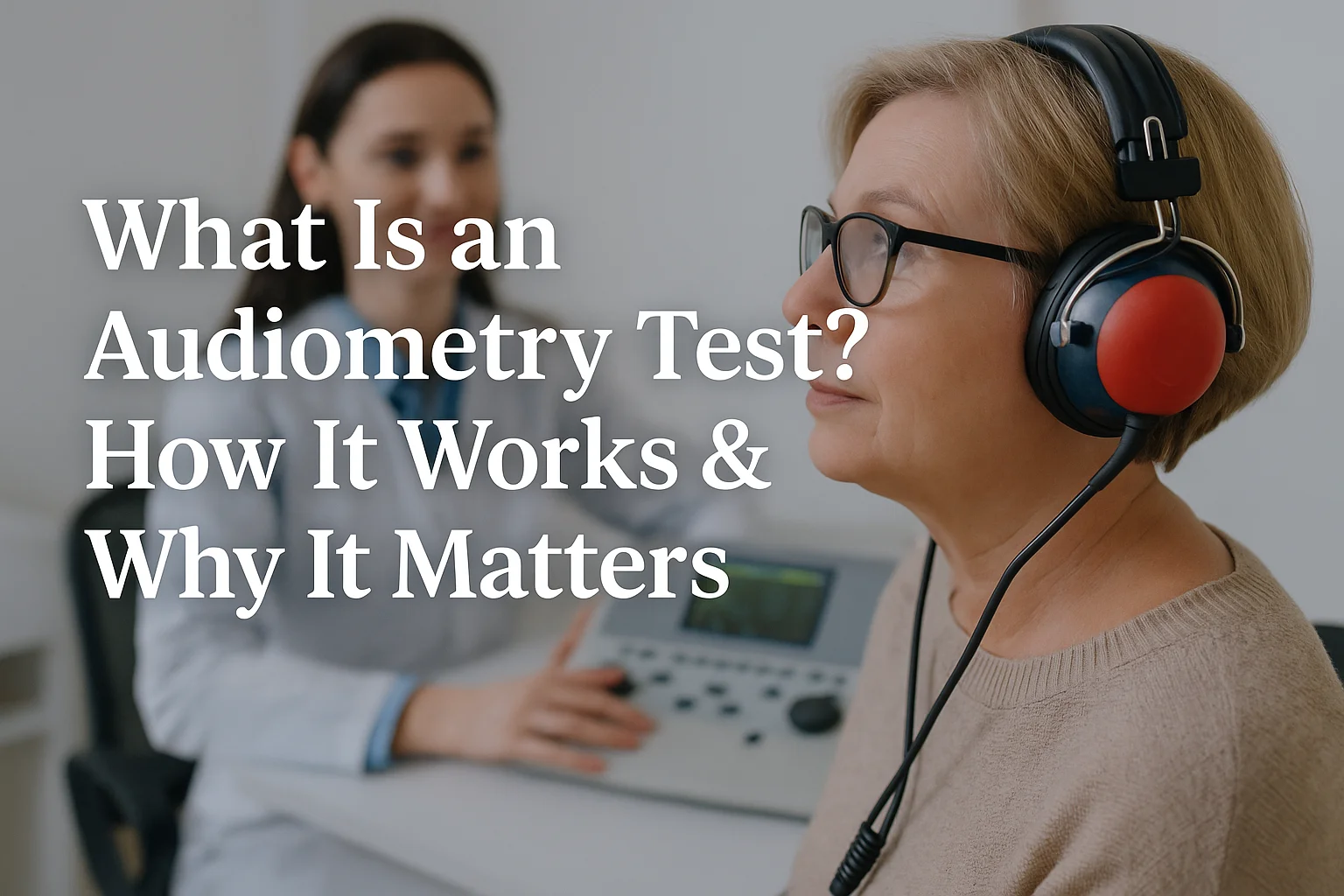
An audiometry test is a specialised examination conducted by a licensed Audiologist to measure an individual’s ability to hear and understand sounds. The term audiometry literally means the measurement of hearing.
Definition in Simple Terms
Imagine your hearing is a stereo system. An audiometry test systematically checks every speaker, wire and setting to ensure the entire system is working correctly. It is a comprehensive, non invasive assessment of the entire auditory pathway, from the outer ear canal to the auditory nerve and brain.
What It Measures
A thorough audiometry test measures three primary aspects of hearing:
-
Hearing Sensitivity (Threshold): This is the quietest sound (measured in decibels, or dB) you can hear at different pitches (measured in Hertz, or Hz). It determines the degree of hearing loss.
-
Frequency Response (Pitch): This measures your ability to hear different pitches, from low-frequency sounds (like a deep voice or a bass drum, 250 Hz) to high-frequency sounds (like a bird chirp or a whistle, 8000 Hz). It determines the pattern of hearing loss.
-
Clarity (Speech Understanding): This assesses not just if you hear the sound, but how well you can understand spoken words, especially in quiet and noisy environments. It determines the impact of the hearing loss on daily life.
Screening vs. Diagnostic Audiometry
It’s important to distinguish between the two main types of hearing checks:
-
Screening Audiometry: A quick, basic check (often conducted in schools, workplaces, or primary care settings) that determines if hearing thresholds are within the normal range at a few key frequencies. It’s a pass/fail test.
-
Diagnostic Audiometry: The full, detailed test performed by an Audiologist. It involves multiple procedures to accurately map out the degree, pattern and type of hearing loss and is essential for determining the appropriate treatment plan. This is the test we are detailing in this guide.
3. Who Needs an Audiometry Test?
Audiometry tests are not just for people who suspect they have a problem. They are a critical tool for monitoring ear health across the lifespan. You should consider getting a diagnostic audiometry test if you fall into any of the following key scenarios:
-
People with Suspected Hearing Loss: The most common reason. This includes people who often ask others to repeat themselves, turn the TV volume up excessively, or struggle to hear conversations in noisy restaurants.
-
Tinnitus, Ear Fullness, or Dizziness (Vertigo): Persistent ringing, buzzing, roaring, or hissing in the ears (tinnitus) is frequently associated with hearing loss and requires a full audiometric evaluation. Feelings of pressure or dizziness can also point to issues within the middle or inner ear.
-
Children with Speech or Language Delay: Difficulty hearing can directly impede a child’s ability to correctly acquire speech and language skills. An audiometry test is a standard first step in their evaluation.
-
Seniors with Age Related Hearing Changes (Presbycusis): Hearing ability naturally declines with age. Annual testing allows for proactive management to maintain cognitive health and social engagement.
-
Occupational Noise Exposure (Factory Workers, Musicians, Military Personnel): Anyone regularly exposed to loud noise (over 85 dB) is at risk of Noise Induced Hearing Loss (NIHL). Regular monitoring (part of an occupational health program) is essential to track and prevent further damage.
-
Patients on Ototoxic Medications: Certain drugs (ex-, specific antibiotics, chemotherapy agents and high dose aspirin) can damage the inner ear. Audiometry tests are used before, during and after treatment to monitor for any drug induced hearing changes.
4. Types of Audiometry Tests
The term audiometry test is an umbrella for several specific procedures that provide a complete picture of your hearing system. A comprehensive diagnostic session will typically include multiple types of tests.
A. Pure Tone Audiometry (PTA)
This is the most fundamental and recognized part of a hearing test. It establishes the hearing threshold: the softest sound a person can hear at specific frequencies.
-
Air Conduction (AC): This tests the function of the entire auditory system (outer, middle and inner ear) using headphones or insert earphones. Tones travel through the ear canal, middle ear bones and stimulate the inner ear.
-
Bone Conduction (BC): This bypasses the outer and middle ear. A small vibrator is placed on the mastoid bone behind the ear. It sends vibrations directly to the inner ear (cochlea). By comparing AC and BC results, the audiologist can determine the type of hearing loss (conductive, sensorineural, or mixed).
-
How Results are Shown (Audiogram Explanation): The results are plotted on a chart called an Audiogram. This graph is the map of your hearing. The vertical axis represents loudness (dB) and the horizontal axis represents pitch (Hz). Symbols (usually ‘X’ for the left ear and ‘O’ for the right ear) are plotted to mark the quietest sound you can hear at each frequency.
B. Speech Audiometry
While PTA measures hearing sensitivity, speech audiometry measures understanding.
-
Speech Reception Threshold (SRT): This is the quietest level (in dB) at which a person can correctly repeat simple two syllable “spondee” words (like “baseball” or “hotdog”). This is used as a cross check for the PTA results.
-
Word Recognition Score (WRS) or Speech Discrimination Score: This is a crucial measure of clarity. You listen to single syllable words (like “cat,” “bike,” “sun”) presented at a comfortable listening level and repeat what you hear. The score is given as a percentage. A low WRS indicates that even if the sound is loud enough, the person struggles to understand the clarity of the speech signal.
C. Tympanometry
This is an objective test (meaning it requires no behavioural response) that evaluates the middle ear function.
-
How it Works: A small probe is inserted into the ear canal, which changes the air pressure. The machine then measures how well the eardrum (tympanic membrane) moves.
-
What it Detects: Tympanometry helps detect common middle ear issues, such as:
-
Fluid behind the eardrum (common in ear infections, or otitis media).
-
A perforated eardrum.
-
Issues with the ossicles (the three small middle ear bones).
-
Eustachian tube dysfunction.
-
D. Otoacoustic Emissions (OAE)
OAEs are low level sounds naturally generated by the healthy inner ear (specifically, the outer hair cells of the cochlea) in response to sound.
-
Used for Newborn Screening: OAE testing is widely used as a quick, objective screen for newborns and infants.
-
How it Works: A tiny probe with a microphone and speaker is placed in the ear canal. The speaker plays a sound and the microphone listens for the tiny “echo” (the emission) produced by the cochlea.
-
Interpretation: A strong, measurable OAE suggests a healthy cochlea and a hearing threshold better than 30 dB. The absence of an OAE suggests a problem in the inner ear or a block in the ear canal.
E. Auditory Brainstem Response (ABR)
The ABR test measures how the auditory nerve and brainstem respond to sounds.
-
For Babies or People Who Cannot Give Responses: It is essential for testing infants, young children, or adults who cannot reliably participate in behavioral (subjective) tests like PTA (ex-, due to developmental delay or cognitive issues).
-
How it Works: Electrodes are placed on the head and earlobes, and clicks or tones are played through headphones. The electrodes record the electrical activity (waves) generated as the sound travels up the auditory neural pathway to the brainstem.
-
Interpretation: The audiologist analyzes the waveform pattern and timing to estimate the individual’s hearing sensitivity and ensure the auditory pathway is functioning correctly.
5. How the Audiometry Test Works
A diagnostic audiometry test is conducted in a calm, controlled environment and typically follows these steps:
1. Initial Consultation (Case History)
The Audiologist will begin by taking a detailed case history. You will be asked about your symptoms (when the hearing loss started, do you have tinnitus, dizziness, or ear pain), medical history, noise exposure history and any ototoxic medications you are taking. This information guides the testing strategy.
2. Otoscopy (Physical Exam of the Ear Canal)
Before any testing begins, the Audiologist uses an otoscope to look into your ear canal and examine the eardrum. They check for blockages like earwax (cerumen), infections, foreign objects, or perforations, all of which can affect test results.
3. Test Inside a Soundproof Booth
Most diagnostic testing is conducted inside a small, sound attenuating booth. This ensures that the only sounds you hear are the ones presented by the equipment, guaranteeing the accuracy of the delicate threshold measurements.
4. Wearing Headphones/Insert Earphones
You will be fitted with headphones or, more commonly, foam tipped insert earphones. These deliver the sound stimulus directly to each ear independently for precise measurement. For bone conduction, a small oscillator will be placed behind the ear (on the mastoid bone).
5. Responding to Tones or Repeating Words
-
For PTA: You will hear a series of pure tones (beeps) at different pitches and loudness levels. Your task is simple: to press a button or raise your hand every single time you hear the tone, no matter how faint.
-
For Speech Audiometry: You will be asked to repeat words (either quietly or at a normal level) played through the earphones.
-
For Objective Tests (Tympanometry/OAE): You simply sit still while the automated machine takes its measurements.
6. Audiologist Notes Thresholds and Clarity
Throughout the test, the Audiologist meticulously notes the softest level at which you responded for each pitch, as well as the percentage of words you correctly repeated. This data forms the basis of the audiogram and the final report.
6. Understanding Your Audiometry Results
The audiogram is the cornerstone of your hearing health assessment. Learning to read it is key to understanding your diagnosis.
What the Audiogram Chart Means
The Audiogram is a graph with two axes:
-
Vertical Axis (Intensity/Loudness): Measured in Decibels (dB Hearing Level), representing how loud a sound needs to be for you to hear it. The top of the chart is quieter (0 dB) and the bottom is louder (100+ dB).
-
Horizontal Axis (Frequency/Pitch): Measured in Hertz (Hz). The left side represents low frequencies (e.g., 250 Hz, like vowel sounds or background hum) and the right side represents high frequencies (e.g., 8000 Hz, like consonants ‘s’, ‘f’, ‘th’, or a telephone ring).
Degrees of Hearing Loss
The degree of hearing loss is determined by where your plotted thresholds fall on the dB scale:
| Degree of Hearing Loss | Hearing Threshold Range |
|---|---|
| Normal | 0 dB to 25 dB |
| Mild | 26 dB to 40 dB |
| Moderate | 41 dB to 55 dB |
| Moderately-Severe | 56 dB to 70 dB |
| Severe | 71 dB to 90 dB |
| Profound | 91 dB and greater |
What Different Patterns Indicate (Type of Loss)
By comparing the results of the Air Conduction (AC) and Bone Conduction (BC) tests, the Audiologist determines the type of hearing loss, which points to the location of the problem:
| Type of Loss | Description | Location of Problem | BC vs. AC Thresholds |
|---|---|---|---|
| Conductive | Difficulty transmitting sound through the outer or middle ear. | Ear Canal or Middle Ear (Wax, Fluid, Ossicle damage) | BC thresholds are significantly better than AC thresholds. |
| Sensorineural | Damage to the inner ear (cochlea) or the auditory nerve. | Inner Ear (Cochlea/Hair Cells) or Auditory Nerve | BC thresholds are the same as AC thresholds. |
| Mixed | A combination of both conductive and sensorineural issues. | Both Middle and Inner Ear | BC is better than AC, but both show a loss. |
For example, a sloping loss is common, where hearing is normal or near normal in the low frequencies but gets progressively worse in the high frequencies, making high pitched speech sounds difficult to hear.
7. Why Audiometry Tests Matter
The significance of the audiometry test extends far beyond just knowing if you have a hearing loss, it is about proactive health management and maintaining a high quality of life.
-
Detect Hearing Issues Early: Early diagnosis ensures the issue is identified at its most treatable stage, often before it significantly impacts daily life.
-
Prevent Further Damage: For those with NIHL, testing leads to the recommendation of proper hearing protection, halting the progressive damage.
-
Improve Communication & Quality of Life: Treating hearing loss removes communication barriers, reducing frustration, stress and the social isolation that often accompanies untreated hearing loss.
-
Identify Causes Behind Tinnitus or Dizziness: The test results can provide crucial diagnostic clues for the underlying cause of persistent ringing (tinnitus) or balance problems (vertigo).
-
Help Children with Speech Delays: An accurate audiogram is the essential first step in determining if a child’s speech delay is rooted in an inability to hear the fundamental sounds of language.
-
Recommend the Right Hearing Aids or Treatment: The audiogram is the precise blueprint used by the Audiologist to select, program, and customize hearing aids or other assistive listening devices, ensuring the technology perfectly matches the individual specific hearing profile.
8. How Accurate Is an Audiometry Test?
When performed by a certified, experienced Audiologist using calibrated equipment in a controlled environment, an audiometry test is considered a procedure of high clinical accuracy.
The results are highly reliable for determining hearing thresholds and the type of loss.
Factors Affecting Accuracy
While the procedure itself is precise, a few factors can influence the outcome:
-
Calibration of Equipment: The test relies on the audiometer being regularly calibrated to national standards. Reputable clinics ensure their equipment is always up to date.
-
Role of Environment: The soundproof booth is critical. If testing is done in a noisy room, the thresholds will appear poorer than they actually are.
-
Patient Responses (Subjective Nature of PTA): Pure Tone Audiometry is a subjective test, meaning it relies on the patient’s honest and consistent response. An experienced Audiologist uses techniques (like cross checking PTA with SRT) to ensure the patient responses are reliable.
9. How Often Should You Get an Audiometry Test?
Regular testing is a key component of preventative health, similar to dental check ups or eye exams.
-
Adults (Under 50): Every 1-2 years, especially if you have a known history of noise exposure or ear issues.
-
Seniors (Ages 50+): Annually. As the risk of presbycusis increases, annual checks help monitor changes and ensure timely intervention.
-
Children: If a speech or language delay is suspected, a history of frequent ear infections, or failure of a school screening.
-
Noise-Exposed Workers: Every 6-12 months, as mandated by occupational health safety protocols, to monitor for permanent threshold shifts caused by workplace noise.
10. When to See an Audiologist Immediately
While routine checks are important, certain symptoms warrant an immediate appointment:
-
Sudden Hearing Loss: A rapid, unexplained decrease in hearing, often in one ear. This is considered a medical emergency requiring immediate consultation.
-
Persistent Ringing/Buzzing: Tinnitus that does not go away or significantly interferes with sleep/concentration.
-
Trouble Hearing in Noise: If you constantly struggle to follow conversations in group settings or restaurants.
-
Ear Fullness or Pain: A sensation of pressure or blockage that doesn’t resolve.
-
Difficulty Understanding Conversations: If you hear people talking, but the words sound muffled or unclear (a classic sign of high frequency loss).
11. Audiometry Test at EarFit:
At EarFit, we understand that a hearing test is the first crucial step toward reconnecting you with the sounds of your life.
We offer:
-
Quick, Painless, Accurate Tests: A comprehensive assessment conducted in a comfortable, clinical environment.
-
Certified Audiologists: Our team consists of licensed, highly experienced professionals specializing in diagnostic audiometry and personalized hearing care.
-
Advanced Diagnostic Equipment: We utilize state-of-the-art, regularly calibrated audiometers and testing tools to ensure the reliability of your results.
-
Hearing Aid Trial & Fitting Support: Should you need hearing aids, we provide customized fitting, programming, and follow-up support based entirely on your unique audiogram.
Take control of your hearing health today. The sounds of life are waiting for you.
12. FAQs About Audiometry Tests
Q: Does an audiometry test hurt?
A: No, a standard diagnostic audiometry test is completely non invasive and painless. The worst you will experience is a brief feeling of pressure in the ear canal during the tympanometry test.
Q: How long does the test take?
A: A full diagnostic audiometry evaluation, which includes Pure Tone Audiometry, Speech Audiometry, and Middle Ear Analysis (Tympanometry), typically takes between 45 minutes to one hour.
Q: Is audiometry safe for kids?
A: Yes, it is entirely safe. In fact, specialized objective tests like OAE and ABR are specifically designed for infants and young children, requiring them only to be quiet or asleep to ensure accurate, timely diagnosis.
Q: Can it detect tinnitus?
A: While the audiometry test itself measures hearing loss, the results (the type and pattern of any identified hearing loss) are the single most important diagnostic tool for understanding the underlying cause of your tinnitus.
Q: Will I immediately know my results?
A: Yes, immediately following the testing, the Audiologist will sit down with you to review your audiogram, explain the results, discuss the type and degree of any loss, and recommend next steps, including any treatment or management options.